
The Big Plastic Count 2026
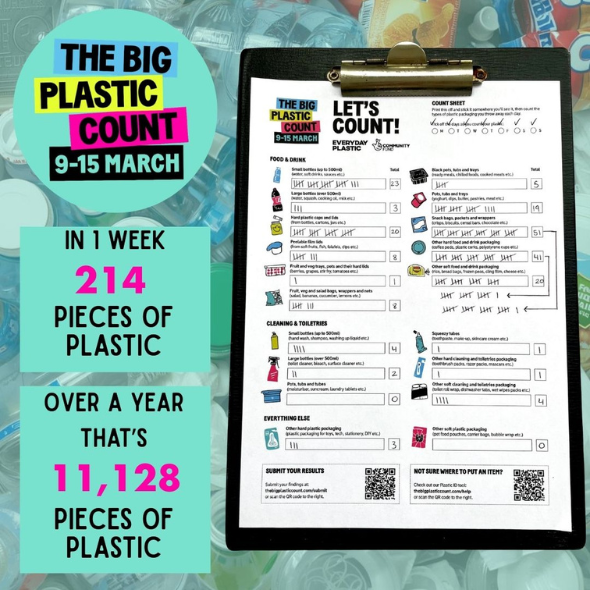
My name is Ella; I am an apprentice waste prevention officer in the Council. I’ve always known plastic is everywhere in our daily lives, from water bottles to food packaging, but most people rarely stop to think about how much we throw away. This is where the Big Plastic Count comes in. This is a campaign supported by organisations such as Greenpeace UK, encouraging people across the country to track the amount of plastic waste they use for one week. I decided to take on this project with my family to help reveal the true scale of the problem and push for changes that could reduce plastic pollution in the future.
Starting the plastic count
At the start of the week, I began paying much closer attention to the plastic items my family and I used each day. Normally, items like food wrappers, drink bottles and coffee pods are thrown away without a second thought. However, having to count every piece of plastic made me realise just how often we rely on it. Even after the first day, the number of items had already started to add up.
Over the next few days, we continued recording everything we used. Most of our plastic came from snack bags, packets and wrappers. During the count, I did some extra research and approximately 6 to 8 million crisp packets are thrown away alone in the UK every year. This really made me think how much one household contributes to this.
By the middle of the week, my family and I had already collected a noticeable pile of plastic waste. Seeing it all written down made me really think about the scale of the issue. That day was our weekly food shopping day, and it really made us think more carefully about the choices we make when shopping and whether there are alternatives with less packaging. However, we quickly realised how difficult it is to find everyday products without packaging that contains any amount of plastic. This made me realise that the issue can’t always be the consumers’ responsibility, but also the supermarkets and manufacturers who choose how their products are packaged, and what options are available to shoppers.
Are there alternatives?
After some research, I noticed not all brands and manufacturers use plastic packaging. For example, Lush uses naked packaging, Notpla uses seaweed capsules and Flexi-Hex in the UK who sell Honeycomb fillers and sleeves package their products in FSC® certified paper. Many brands are starting to make a change, and it looks like more are on their way.
How much plastic did we get thorugh?
At the end of the week, I was shocked by the results of our count. I hadn’t realised just how much plastic a family of five could go through in only seven days. Seeing the total number of items written down really showed the scale of the problem. During the week, our family of 5 counted 51 snack bags, packets and wrappers, as well as 41 other food and drink packaging. In total, we used 199 pieces of plastic in food and drink products, 12 for cleaning and toiletries and 3 in other packaging.
What we learnt
This experience has made me think much more carefully about the choices my family and I make. In the future, I will try to look for products with less packaging, choose reusable options when possible and avoid single-use plastics when there are alternatives. However, the biggest change needs to be made by manufacturers and supermarkets in their packaging. Taking part in the Big Plastic Count has been a big eye-opening experience, and although I do feel guilty about how much plastic we use, I also understand that my family and I are only a small part of a much bigger problem across the UK.